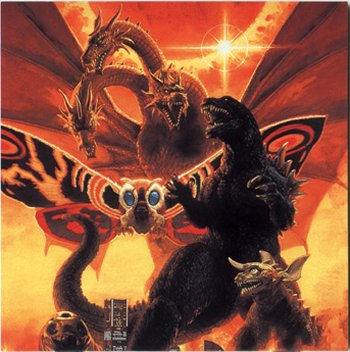
© 2001 Lawrence Tuczynski
| Title: | GODZILLA, MOTHRA, KING GHIDORAH: GIANT MONSTERS ALL-OUT ATTACK |
| Japanese Title: | Gojira, Mosura, Kingu Gidora: Daikaijû soukougeki |
| CD Label: | TOKUMA JAPAN COMMUNICATIONS |
| CD Number: | TKCA-72279 |
| Music by: | Kow Otani |
| Number of tracks: | 36 |
| Running time: | 57:37 |
| Number of discs: | 1 |
| Year of release/manufacture: | Dec. 6, 2000 |
| Year movie released in Japan: | Dec. 2001 |
| Year movie released in US: | 2003 on DVD |
| REVIEW |
December 16, 2001 - Review Courtesy of David Hirsch Some people believe a Godzilla film can only be scored by Akira Ifukube. They’ll probably hate this score. However, those not restricted by that edict (and especially those like myself who loved Kow Otani’s Gamera music) will find this score a fresh and original departure from what has been done before. Although primarily orchestral in nature, Otani peppers the score with a vast array of electronic effects and choral vocals, a technique he refined over the Gamera series and his last film, “Cross Fire.” Three primary themes are reflected throughout the score, though the new 8 figure “Destruction God” theme for the evil Godzilla is most often used, the more expressive religious theme for the trio of Japanese kaiju gods (most expressively used in “God Of Water - Mothra”) and the memorable motif “Determined To Protect The Future,” are Otani’s most expressive and touching musical phrases. There is also a military march (tracks 18 & 19) that makes it’s appearance last in the film. Otani’s Godzilla theme, like his Gamera theme, is actually quite short and simple, but very effective when counter mixed with other motifs. This gives the whole film a constant sense of imminent destruction. Godzilla is a major threat to Japan, and all forces, both man and monster, have little time to stop him. As with the previous two films, Ifukube’s music does make an appearance here as the end titles, comprised of the maestro’s original Godzilla themes and the “The Great Monster War March.” The one failing of this album stems from presentation. The tracks are presented as individual cues. This lack of crossfades breaks some of the momentum established by Otani's melodies. Also the edit in the “End Title” between Ifukube’s themes and Otani’s “Main Title” is just appalling. |
|